Software Management
A Skills Wheel for Product Designers
18 Oct 2026
Twice a year I sit down with each person on my team and talk about their skills. For product managers, I use Petra Wille’s PM Wheel. I love it.
The PM Wheel is simple. It’s a circle with eight spokes, each one a skill a product manager needs. You score yourself on each spoke from 0 at the center to 8 at the edge, then connect the dots. What makes it work is the set of questions behind each skill. "Rate your stakeholder management" is a meaningless question; everyone gives themselves a six. Answer twenty specific questions about how you actually manage stakeholders and the number means something. The PM fills one out, I fill one out, and we compare shapes. The gaps between my wheel and theirs are where the useful conversation lives. I don’t use it for performance reviews or promotion cases. It’s a map of where someone is and a starting point for deciding where they want to go next.
I also manage designers, and I wanted the same thing for them. So I went looking.
Prior art
The first place I landed was Jason Mesut’s work on Shaping Design. Mesut has been thinking about how to profile designers for close to twenty years. His blob mapping exercise has a designer draw a freehand shape across practice areas like user research, interaction design, information architecture, and visual language, then add arrows showing where they want to grow. Later he worked with a recruiting firm on a digital version called the UX Spectrum.
There’s a lot of good thinking in Mesut’s work, but I couldn’t find a canonical version of it. It lives in conference talks, podcast interviews, Medium posts, and his paid workshops. The UX Spectrum tool was taken down, and you have to dig through the Wayback Machine to find it. When he wrote a post in 2026 about what skills designers should invest in now, his answer was that it depends, and he pointed readers back to his older posts. That’s an honest answer, but I can’t hand it to a designer and ask them to fill it out.
More importantly, Mesut built his shapes for self-reflection. The designer draws their own blob and uses it to think about their career. That’s valuable, but it’s a different job than a manager and a designer comparing notes on how the designer’s skills are developing.
Nielsen Norman Group built on Mesut’s work and turned it into something more usable. Their skill mapping article comes with a Google Sheets template that plots each person on a radar chart and then overlays everyone into a combined team shape. It’s well made and easy to use.
It’s also answering a different question. The template starts from six very broad categories, and they read as disciplines rather than skills. The article then suggests you pick your own skills to evaluate, which muddies things further, because a discipline and a skill aren’t the same kind of thing. Where the NN/g map shines is team composition. Lay everyone’s shapes on top of each other and you’ll see that you’re heavy on visual design and nobody’s strong in information architecture. That tells you who to hire next. It’s a census of the team.
It doesn’t tell you much about an individual designer. I expect a designer to spike in one or two disciplines, be adequate in a few more, and be mediocre in the rest. That’s what a healthy designer looks like. A visual designer who scores low on research is showing me their specialty, and I’m not going to try to close that gap. If I used a discipline map to drive development conversations, I’d end up pushing every designer toward being a generalist, and I don’t want that.
What I wanted instead
The PM Wheel works because its spokes are skills, not disciplines. Every product manager does discovery, works with stakeholders, and thinks about strategy, whether they came up through engineering, design, or sales. The wheel measures how well they do those things.
I wanted the same thing for designers. Specifically, for product designers — the people who design the flows, screens, and systems of a product, as opposed to brand designers or dedicated researchers. A product designer will still have a spike. Someone might be exceptional at interaction design and merely solid at visual polish. But every skill on the wheel is something a product designer practices in their everyday work, so a low score is worth a conversation. The wheel isn’t asking anyone to be an eight everywhere. Neither is the PM Wheel.
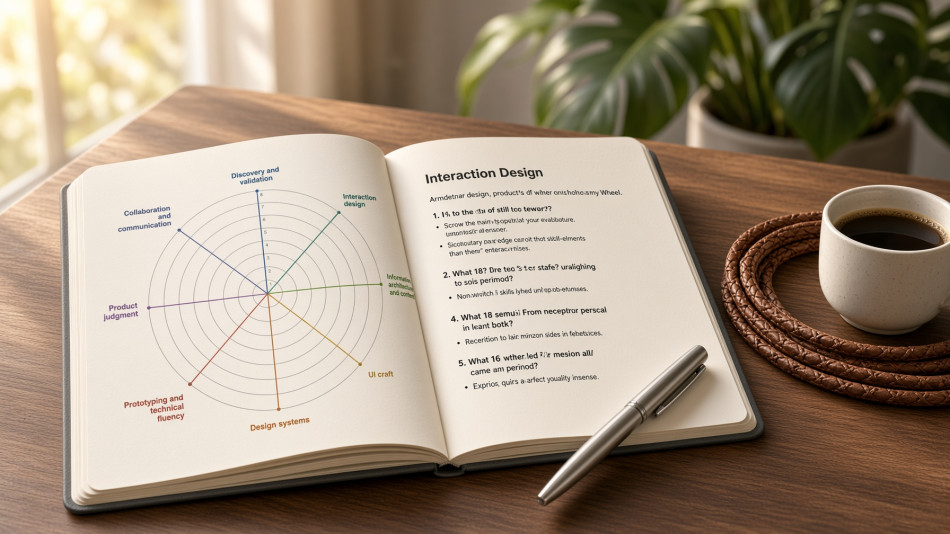
Here are the eight skills I settled on:
- Discovery and validation. Framing the problem, then testing ideas with users through usability tests, quick interviews, and analytics. This is research at the depth a product designer actually practices it, not a full research program.
- Interaction design. Flows, states, edge cases, and error recovery. Thinking past the happy path.
- Information architecture and content. Structure, navigation, naming, and microcopy. Users can’t use what they can’t find or understand.
- UI craft. Hierarchy, layout, density, polish, and accessibility. Making screens clear and finished, not merely correct.
- Design systems. Thinking in components, keeping things consistent across surfaces, and extending the system without forking it.
- Prototyping and technical fluency. Building testable prototypes at the right fidelity, including code or AI-built ones, and knowing what’s cheap or expensive to build.
- Product judgment. Tradeoffs, scoping to the smallest useful version, and tying design to user and business outcomes. This is what separates a product designer from someone executing a spec.
- Collaboration and communication. Partnering with product and engineering from the start through ship, defending decisions with evidence, and giving and taking critique.
The first six are where you’ll see a designer’s specialty show up. The last two cut across everything. A designer with a weak score in product judgment or collaboration has a problem regardless of their spike.
Each skill comes with 16 to 18 questions, the way Wille’s do. They’re written so the designer can answer them about themselves and their manager can answer them about the designer. A few examples from interaction design:
- Do you design empty, loading, error, partial, and success states without being reminded?
- Do you find edge cases before engineering does?
- Do you treat every surface customers touch (email, notifications, help content, APIs, other channels) as part of the product, and design flows that move across them?
That last one reflects how I think about design. The API, the docs, and the emails a product sends are all part of the product. A designer who draws a line around the screens and calls everything else someone else’s problem is missing half the job.
Using it
The wheel is scored the same way as the PM Wheel, 0 to 8 on each spoke. The designer fills one out. I fill one out in a different color. We sit down and compare. The questions keep the scores honest, and the differences between the two shapes give us something specific to talk about.
You can download the Product Designer Skills Wheel as a PDF, with the blank wheel on the first page and each skill’s questions on the pages after it.
Petra Wille’s PM Wheel is the best tool I’ve found for developing product managers. I’ve tried to build something with the same spirit for designers: specific enough to score, broad enough to fit any product designer, and focused on growth instead of judgment. I hope I’ve done her model justice. If you use it, I’d like to hear what works and what doesn’t.